
Rice Cooker
Linthoi Ningthoujam
The bus felt different. She instantly knew it was a menstruating woman.
Menstruation was something she could not escape from, even when she was not on hers. Someone was always menstruating, and she could just sense it—the slight drooping of the shoulders, the hunch of the back as if protecting oneself from the torture, the universe trying to get out of the uterus while blood made its way to the rag. A pad was also a rag. Just a slightly better rag. The only difference was that it had to be paid for. To someone like her, it was a waste of hard-earned money, unless it was for her daughter.
She had believed that by her daughter’s time there would be inventions. A device, an effective pill, magic, anything – at no cost – to make those days seem like any other day. It shouldn’t completely go away, though. That would be too much of a shock, and she wouldn’t know how to plan her life without it. Merely something to help with the discomfort and the dampness.
For her daughter, she wished for something to ease the pain and exhaustion that caused her to miss school a few times every month; something to compensate for the time lost. As a working woman, she knew all that mattered in the end was time.
There was the car, the washing machine, the mobile phone. Still nothing for the menses.
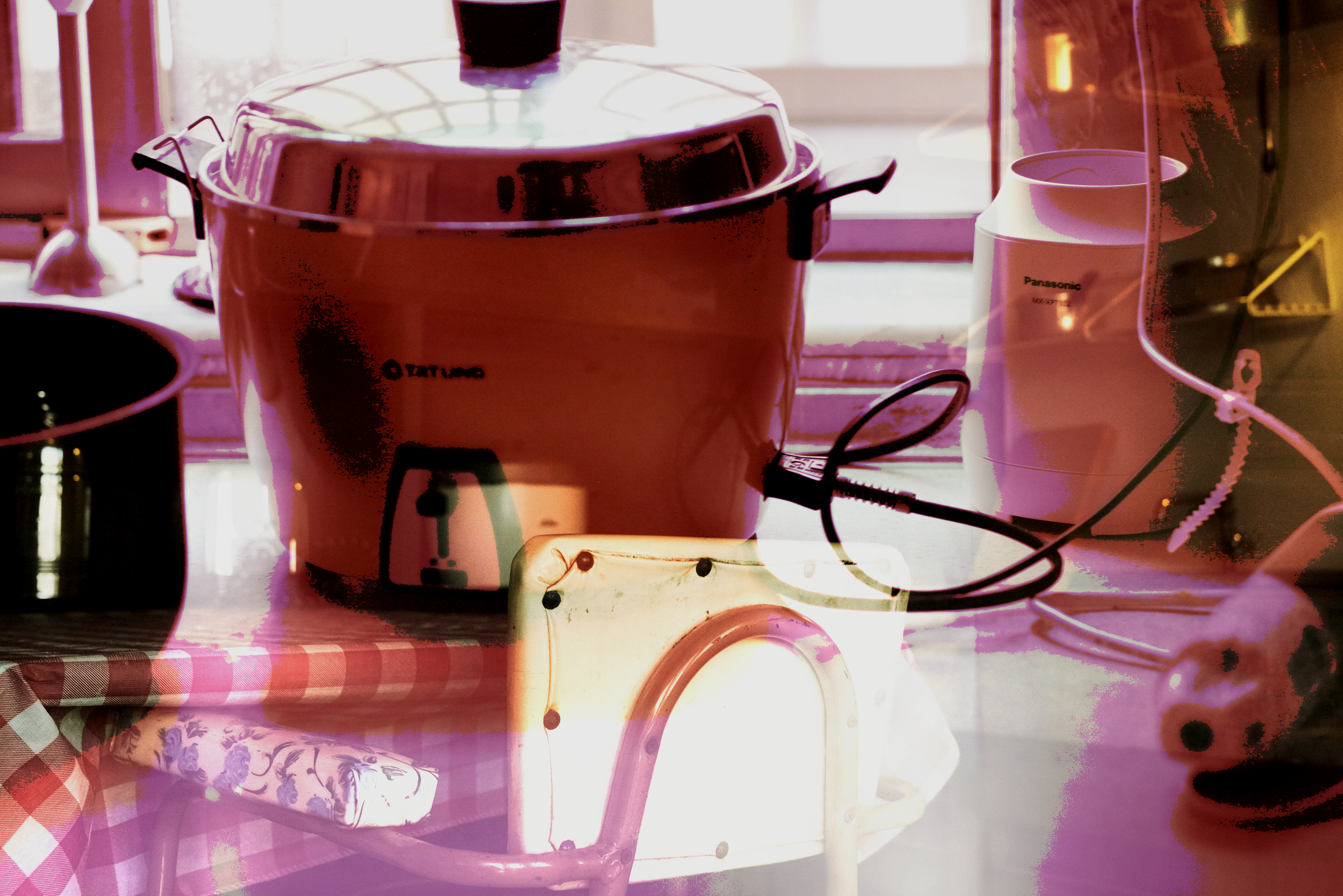
There was also something called a rice cooker.
The mistress of the house she worked at as a help loved to collect appliances, whether or not they were used. To her, who had recently installed cooking gas in her kitchen, they were rich peoples’ ways to squander money. Until she saw the beautiful white rice cooker at her employer’s kitchen. She had never touched it. She had always been wary of anything run by electricity. Just as she didn’t trust the state electricity department, she didn’t trust what they were providing. Or not. She admired the appliance’s efficiency, though. No doubt about it.
White, soft, sticky rice in a matter of a few minutes; it must have been made by Goddess Imoinu herself.
On the day of her journey, she reached her employer’s house at daybreak. She wore her only good clothing –a semi-silk phanek – inspired by her employer. Her hair was tied in a low bun, pinned with a golden marigold. And dawn dusted her with a pinkish radiance.
Her employer, who conversed in English with her children and wore silk phaneks every day, had her to help with the housework but looked tired all the time. She had deduced that being tired in silk must be better than being tired in old clothes.
She was finishing the mopping when she happened to stand before the long mirror.
She gazed. How dignified she looked! This is how one should dress for work, she thought as she went off to scrub the toilet.
Squatting on the freshly cleaned, Harpic-ed toilet, she emptied her bowels, washed her hands ferociously, and was finally ready for the long road ahead, to Moreh.
*
Her name was Bimola, and she had been orchestrating life like an ancient song.
The bus began its ascent.
All her life Bimola had seen these hills overlapping. Lights interplaying at the turn of each season—from a placid jade to a riot of blue and grey under the rains, to tinges of coppers and browns as the days got colder. But what she remembered most was that one dusk sky, spreading its fluid darkening to the western hills and slowly eating them up.
It was the day her husband was disappeared.
No gunshot no blood no trace.
She had prayed to find his body. Dried blood cracking on his back, his lifeless form tucked by a foothill
somewhere, waiting for her…
She had imagined how she would laugh in relief after offering flowers to the hill deity, for bringing closure to her and her five-year-old daughter, Tombi.
That imagined moment never came.
Bimola’s life was nothing short of a cliché. Growing up in the outskirts of Imphal, she’d had only the bare facilities to survive life. Nevertheless, it had been a happy childhood until her father started drinking occasionally. Then, frequently.
It was at that time that she developed an aversion to the sight of rice boiling—the gruel stage, if one may call it. It reminded her of her father’s vomit after a night of heavy drinking and late dinner.
But she had to see it almost every day; because one had to monitor the pot while cooking rice, open the lid when the boiling began, and watch the simmering gruel. Continue watching to finally cook it on low heat.
Yet, Bimola never thought of it as unfair. It was the story of many other families too. It was the cliché. She was never to view her life as a grand tragedy. So, when her husband went missing, and the years went by, she decided not to blame anyone, nor regret her life. Except for one thing: that unfortunate day, her husband had left for work in a hurry, without having anything. For years to come, Bimola would utter in her nightmares, ‘He didn’t even have one morsel of rice. Not even one chakkhom.’
Before the bus reached Tengnoupal to halt for refreshments, Bimola forced herself to sleep to subdue her hunger. Most people couldn’t sleep hungry; complaining of a growling belly, a nauseous churning of the stomach, an animalistic urge to gobble up an extraordinary amount of rice; what is called ‘chaak-lamba’. Literally, ‘rice-hunger’, not simply ‘hunger.’
Bimola was used to it. Her daughter was not.
Tombi, who had recently graduated college, had eloped with a boy from a well-to-do family, and was to be married. She had grown up without tasting hunger. Besides, Bimola had introduced her to the bliss of adequacy and choice. It was because of what she had made of her daughter that today, she was going to step into a foreign land to buy a rice cooker.
Tombi had disagreed. 'A 3-litre pressure cooker would be more than enough.’ She further said, 'It is not a good time to travel so far. Yesterday, there was news of…'
Bimola wouldn’t listen. She explained, 'A pressure cooker for lentils and eromba. A rice cooker for rice and steamed vegetables.' She reflected that the horror of the ethnic violence had finally subsided. There were no more reports of fire or blood. Trauma was only for the wounded to bear silently, as she herself did. Life would not stop.
She listed her reasons to Tombi:
they belonged to neither of the warring parties
the road seemed to be in good condition
the rains were still a few months away
her menstrual cycle had just ended
She was bursting with energy, and it was the perfect time to go.
*
Bimola wiped off the drool from her mouth and smoothed her hair. She had reached Moreh.
The rented room was a kutcha-walled cabin next to the outhouse of a family who had moved to Moreh almost a decade ago from a far-flung village, leaving behind their life of poverty to find prosperity in the commercial tryst between India and Myanmar.
Having woken up early, Bimola went out to explore; climbed the hill behind the house to reach a fair elevation. Like a sunflower opening to the dawn, she instinctively turned to the east. Everything drifted into the other; a continuation of sky, river, vegetation, the vastness. She realised it was the other country when she saw golden spires of a pagoda rising to meet the clouds.
How is it that everything is a flow, yet it is said that they worship the Buddha? Is this what it means to be foreign? Is my neighbour Chaobi foreign then? Chaobi, who recently converted and started going to the church? How could Chaobi be foreign? We went to a swasti puja together last week. Ah, whatever!
These were hard questions and she had nothing to do with them.
She looked out again.
Is this the borderland that will fulfil my dream? Is this the borderland that will serve my daughter rice, always warm and ready to eat? For the rest of her long long life?
This—she had everything to do with.
It wasn’t difficult to reach Tamu, the trading town in Myanmar. Everyone was going there. She merely had to follow the crowd. If any help was needed, one only had to ask aloud. Everyone was in a rush, but someone always answered. For her, it was a Tamil woman who assisted her in finding a PCO. After the call, Bimola remembered her forgotten water bottle and bought one from her.
Thus, this was good for business: to be helpful and kind. All the shopkeepers, vendors, and even the customers were. It was like a cycle: kindness was good for money; and the more money one had, the kinder one could afford to be. The cosmopolitan borderland seemed to have it figure it all out.
Bimola could read the ‘Y2K’ printed on t-shirts hanging in the bustling market. That was as much as she could decipher. She was glad that Tombi’s would-be father-in-law himself had insisted Tombi pursue a master’s degree. He had said, 'We are a progressive family. Our daughter-in-law will work in an office.'
That was the moment that Bimola felt she had to buy a rice cooker. It would make everything easier for Tombi, and give her more time for her studies.
The rice cooker was a headache to find. There weren’t many in the market yet. As determined as she was, Bimola was also far-sighted and sharp. She’d made friends with an elderly woman – an experienced businessperson – on the bus, and asked for her help.
The woman, on her best professional behaviour, had asked, “Is it for personal use or business?'
'A wedding gift for my daughter.'
'Heima! Let’s go find it then.'
The rice cooker was dull and plain. A white pot with a steel lid. Bimola didn't haggle and paid what was asked. The rest of the day was spent accompanying the woman, who was friendlier after learning about the wedding. She suggested Bimola also buy bedsheets, blankets, cosmetic items, and various other things. Bimola nodded at all of them, but could not afford to spend more money.
The border gate was due to close at 5PM. They rushed back and had dinner together at a rice hotel. Perhaps it was the rush of returning, the relief of not being stranded on foreign soil, or a sense of pride at herself, but Bimola splurged on the meal. She even offered to pay for the woman’s meal, and had her most satisfying dinner in a long time.
*
The wedding was a success. Both parties had agreed to keep it dignified rather than making an ostentatious display of wealth, which both admittedly didn't have much of.
At the parting ritual, blessing her daughter, Bimola said, 'Make the most of your new life.'
Tombi lightly covered her head with a mustard-yellow phee and served evening tea to her father-in-law.
In a warm voice, the retired clerk said, ‘Yaida. It’s alright. You don’t have to cover your head. These are outdated customs.' Sipping the tea, he turned to his son. 'The lady officer in my office wears trousers and no phee to work. She is married. With children, too! Our mou will also become an officer someday. She must also wear trousers. They look so smart, don't they?' Looking at Tombi, he then asked, 'It seems you brought a rice cooker?'
'Yes, my mother bought it from Tamu.'
'Your mother is a wise woman. It will make cooking convenient for you. We are excited to taste rice from a rice cooker. Steam some pumpkin chunks, and ngari and chillies, too.
'Yes, Pabung.'
'There is one more thing. Your grandmother will not eat rice cooked in anything but her old pot. It was her wedding gift. You understand how it is. Moreover, she is old, and it's hard to change her mind. Please cook separately for her, as she wished.’
Without replying, Tombi went into the kitchen.
It was the first time the family was to try the new mou’s cooking. Tombi remembered all the minute details her mother had taught her for this rite of passage.
She saw that her mother-in-law had already unpacked the rice cooker. Leaving the kitchen to Tombi, she said, 'I have made preparations for four dishes. It shouldn't be that difficult with the rice cooker around…'
Tombi sighed and began the task.
When she was halfway through preparing the last dish, she washed the rice. Pouring in clean water and gently stirring the mixture with her delicate fingers, she thought of her mother. Her courageous, illiterate mother, who had gone all the way to buy this for her. Her mother, who must be cooking in her old pot, hating herself for having to watch the rice boiling. Tombi was determined to gift her a rice cooker as soon as she started earning.
Before stepping out of the kitchen, she switched on the rice cooker and left it to work its magic.
Tombi sat down near her husband in the courtyard. Just the two of them.
Her period had started that afternoon. She was relieved that it came after the wedding rituals had ended. She couldn’t fathom how she would have managed to even change her pad with the bridal wear—the stiff, heavily decorated potloi. All she wanted now was a painkiller and to curl up in bed. At the same time, she didn’t want her in-laws to find out that she was on her cycle, or she might be banned from the kitchen for five days. Even progressiveness drew the line at menstruation in her part of the world. There was no point in testing them. She told herself it doesn’t matter/ I live here now/ I will do as I please.
Cramps started tightening her body. Thanking god that the rice cooker was doing the cooking, and not her, she leaned her body towards her husband’s. He leaned back. To the world, they were husband and wife. But to each other, they were companions and partners. Each sharing equal affection and respect. Their life was going to be different from their parents’. Not even her fatigue could deter her from feeling this heady optimism, from believing it must be love.
Phaaaaaaaak!!!
Tombi’s heart skipped a bit. But neither of them panicked.
It was not a bomb nor a gun. They knew better.
'It’s that bloody transformer again,' said her husband, bringing out a lit candle to Tombi.
Holding the candle in one hand, she placed the other over her pounding heart.
There was an uncanny darkness. Tombi entered the house carefully.
As she stepped into the kitchen, she felt something slimy under her feet
the candle was lowered
it was rice gruel
all over the floor.
***
About the Author
Linthoi Ningthoujam is a poet and writer from Imphal. Her poems have been published in various literary anthologies and journals, including The Penguin Book of Poems on the Indian City, The Bombay Literary Magazine, Yearbook of Indian Poetry in English 2022, and Witness: The Red River Book of Poetry of Dissent. Her fiction for children was published in Regional Stories of India 2 by Scholastic. ‘Rice Cooker’ is her first story for adults. She works as an assistant professor of English in Imphal.
This story was a runner-up for The Deodar Prize, 2025.