
Objects In The Mirror Are Closer Than They Appear
Pritika Rao
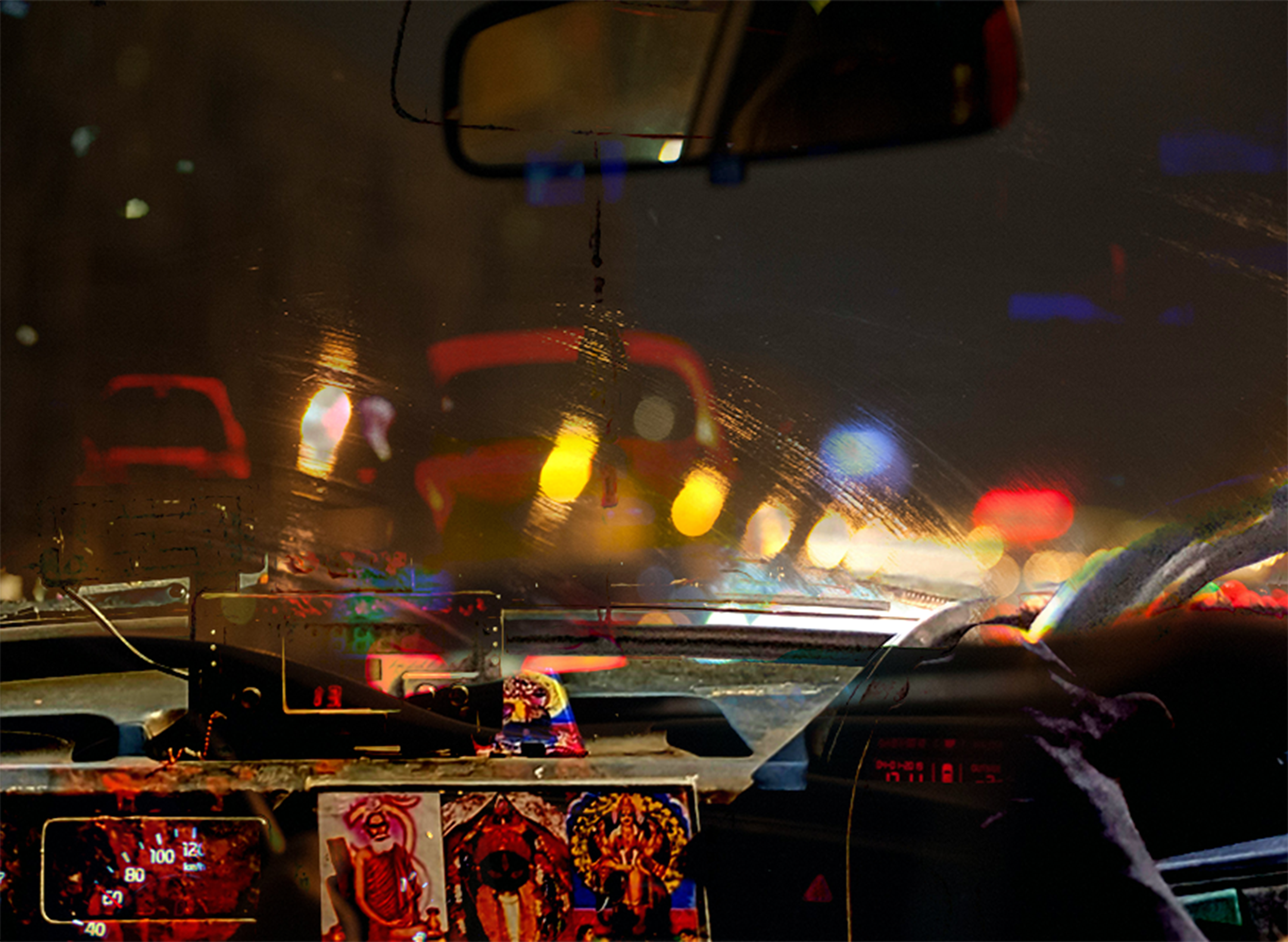
“Mom’s Gift. Dad is Liar” was displayed in aggressive red lettering on the rear bumper. Aside from this, the office cab was just another white sedan with air-conditioning and an ‘In Case of Rash Driving, please call …..’ sticker on the back. I sat on the brown faux velvet with a feeling of triumph. For the first time in the three years that I’d worked at Graphos Advertising, Harsha had agreed to let me pitch to our client. Pulling it off “will require an all-nighter and you know company policy on women staying late,” sneered Harsha. He added a fake sympathetic shrug sometimes to go with it. Still, I had persevered, and what do you know? It only took until 11:45 PM to finish the presentation and review it with the team. I took out my phone to brief Janhvi, an intern and the only other female member on the team. I spoke to her for five short minutes before I realised, as my stomach did an unsettling flip, that we were not driving along the regular route to my house. We should have been on a main road that would lead to the Outer Ring Road. Instead, we were trundling down an irregular lattice of narrow streets, slithering into the dark crevices of the city. The houses we passed were sombre, as if they had been pressed into the ground. Shop shutters were drawn and streetlights, if there were any, cast a menacing light. “I’ll call you later, Janhvi,” I muttered abruptly. I noticed that my hand was shaking as I disconnected the call.
"Naan pickup madilike ---' and then the cab driver’s voice trailed off. Was he going to pick up someone else? He was driving recklessly, so I figured I would say something about that, at least. I closed my computer and asked him to slow down in Hindi. He simply laughed it off, like I was an idiot on a rollercoaster, asking to get off. A sinister smirk spread across his face as his bloodshot eyes met mine in the rearview mirror. He was a mousy-looking man, probably 5’4’’ at most, with salt-and-pepper hair. His shirt was a dull cement grey. The nail of his thumb had grown extra long and was painted a menacing red. All my resolve to assert authority collapsed into the bottom of my stomach.
I don't know what it is exactly about the shift in energy, but when you see a man looking at you a certain way, you feel this vague longing for death. Like you can no longer bear to inhabit your own body, and you're transmogrified into a thing that wants to chew through the sofa fabric, to disappear like an insect. His fidgety movements made me more anxious. I slipped my finger over the latch on the door, trying not to alert the driver. He continued talking in Kannada on the phone, with one of the earphone wires dangling from his mouth, not knowing that even though I couldn’t speak the language, I understood every single word. He probably thought I was a Punjabi because of my complexion. Or a Malayali because of my curly hair. Then he turned on the radio, and the head-splitting beats of music filled the car as he started singing along, his speech slurring slightly.
The driver’s details were framed in a laminated sheet, bearing an Aadhaar number, driving license number and address. This hung like a garland over the back seat, facing me. In occasional flashes of light from passing vehicles and street lamps, I could barely read this information clearly. Still, I tried to take a photo. Blurry. That’s when I noticed that my phone battery was at 6%.
There was a level of forensic detail with which I observed my surroundings after that, in case I needed to remember it later. Oh God, would I even be alive to testify? My throat was closing up. His dashboard was crowded - a cheap version of a Hello Kitty doll bobbing sadly, holding a faded 'ave a nie day!' board. There was a black and white photo that had turned brown, of his parents' wedding, I presumed. They both looked morose and dejected, like living corpses, resigned to this marriage. The sweet smell of a string of jasmine dying, gracefully draped over the rearview mirror. And was he wearing Axe perfume? The air reeked of death and stale socks. I had bursts of violent anger, a ferocious will to live and a strange acceptance of my fate in these circumstances. For some reason, both feelings made me ashamed. What was this curse of being a woman? I hated my body and my gender, and wished I was born a cow. I hated the male body, the obnoxious privilege it inherited, its bitter weakness that manifested as brute strength. I wished that men were born as beetles.
We went hurtling down Long Bazaar, past all the shops I once loved, when I lived in this area many years ago. How often I would read each signboard, the straightforward marching English font, the curved dancing regional alphabet, often slightly mismatched in pronunciation. Darling TV and Electronics, when translated, was phonetically Tarlink TV and Yelecktranics. It gave me a real kick, as a child. Now they all just merged into one another - a blur, like my childhood, flashing before me - Seema Textiles, Farhana Tailoring and Stitching, Ellora Fancy, DLP Sweets, Banu and Sons, Jyoti Driving School, RV Stationery, Manjunatha Bakery, Vasantham Restaurant. It was a mess, but you got everything you wanted here. A whole day, an entire childhood could be spent wandering these streets. I felt a pang of nostalgia. Would I ever walk this stretch again? My heart beat faster and faster, as heavily as the music was buoyant, while we exited this row of shops.
Think, I told myself, think. You know this road like the back of your hand. You haven’t been raped, you’re not dead yet. Think. Think, damn woman, think!
I thought about how I usually sat in cars – most undignified, with my legs up on the seat in some strange position, laptop askew, watching a TV show or reading a book or lying down in the backseat, leisurely talking on the phone. I thought of how the luxury of being able to take a cab rather than public transport had now trapped me in this hell. But who knows? Public transport is hellish for women too. Everywhere we go, we are just carcasses for vultures.
I needed to call someone quickly. Anyone. Should I just call the police? I remember a friend once telling me that if you called 100, it never worked. I should have tried. Should I call the ambulance number - 109? But if I had nothing to say, they would just hang up. I tried Harsha and Janhvi. Neither of them answered the phone. I called my roommate Charu, but when she answered, I didn’t know what to say. I didn’t want to alert the driver and aggravate him any further. So I hung up. Thoughts pressed up against my brain,
making me giddy with unease. I wanted to throw up. Maybe if I did, this cab guy wouldn't want to have anything to do with me.
I rushed past every house of worship, my heart unsettled, a bird in a cage. At the corner, just past a Georgian-style church building, there was a traffic signal that the cab driver seemed oblivious to. Who cares, I thought to myself, I would much prefer to die in an accident than at the hands of this man. I was surprised at the cool clarity with which this thought came to me. In what is typical of Bangalore traffic, an auto swerved in front of us, and a bus switched lanes, so the driver was forced to come to a crashing halt. I fidgeted with the lock, ready to abandon all my belongings and throw myself onto the pavement, ditch or road, but the door didn't open. Meanwhile, the cab driver and the auto driver had cursed each other, their extended families, and their vehicles. My battery was down to 3%. It was so late in the night; who would come to get me? I couldn't think straight. Yet, I thought of the one man who should have. Charu was calling me back as my battery slipped into the dangerous territory of 2%. In a flash of instinct, a rabid forest woman inside me came alive. I would have to do this before the other guy got in. I answered the phone.
“Oh, Appa, you’d gone for the movie tonight, no? Who is with you? SP saar?” I could hear Charu’s confusion on the other end. “What are you talking about? Your dad? Since when do you know his number?” I wanted to weep. But I couldn’t. Not yet. What was the Superintendent of Police’s name again? Rajan something, something…Rajan Babu? I felt the driver become a little skittish. His eyes were nervously darting, looking at me
through the rearview mirror and then at the road. I felt the adrenaline coursing through my body and tried to keep my voice steady. I vaguely remembered the phrase, "Mātā mitraṁ pitā chatraṁ," which meant ‘the mother is a friend; the father is an umbrella.’ My father, as much a stranger as this cab driver, offered no protection from life’s storms. He was merely a concept, but even in theory, an umbrella can serve as a shield.
“Oh, yeah, I can join you, Appa. At Garuda Mall? Sure.” Charu had sensed something was wrong. “I’ll bring Karan to Garuda. Now. Stay on the phone, don’t cut the call.” I heard her tell Karan to call their friend, Sid, who lived near Philomena’s Hospital, very close to Garuda Mall. I turned to the driver and, in a firm tone, told him to drop me off at the next corner, near the entrance to the mall. He began to object. “Drop location change nahi —” He was fussing about the change in route. I waved my hand at him as if he were a troublesome housefly. “Tell Rajan Uncle I say hi, and congratulations about the promotion. Oh, okay, I’ll meet you both downstairs and congratulate him myself.” I then addressed the driver with the last ounce of bravery I could muster. “This is not my usual route anyway; we’re far off from that, so you can just drop me off right in front there”.
I pointed to the crossroad - almost empty of traffic. I knew there would be a security guard and lights there. A movie show would finish soon, so there would be some people exiting the premises eventually. And he would have to let me out - he seemed a bit afraid at the prospect of getting mixed up with someone who knew Rajan Babu. He attempted to bargain for 200 extra rupees since I had changed the drop-off location, but he mercifully stopped the car at the end of the road. It was a small price to pay for freedom, although I owed him nothing for this trip. Tears sprang to my eyes as I heard the click of him releasing the door latch, and I jumped into action. I grabbed my things, threw the money onto the seat, and half-speed walked, half-sprinted up to the entrance of the mall, not turning to look back even once.
I rushed up the stairs to the big glass doors, safe within the premises of the mall, even though the lights were all off. The security guard came running towards me from his post, shouting “Madam, all closed, madam”. I heard his shrill voice fade into a distant hum as I fell to the floor near the electronic scanner by the entrance. Maybe a rat scuttled by, perhaps it was a loose receipt. The ground was filthy, yet I had never felt safer. The guard was saying something, but I couldn't make out a word. I don’t know how long I sat there before I felt Sid hovering over me, asking if I was okay. He patted my shoulder or something, but I never lifted my head, quietly shuddering and sobbing into my bag. Eventually, Charu and Karan arrived too. Only when Charu touched me gently did I let out a guttural scream. I held her and howled in a terrified primal way, like a cornered animal. I stopped myself immediately, embarrassed.
“What happened?” Karan asked gently, visibly worried. 'You OK?' Charu added, her voice a low, soothing whisper. “I’m okay, but I almost, he almost, I don’t know what would have....” and then I couldn't say it. I didn't need to. Charu enveloped me in a warm maternal hug. After a considerable amount of tears and time had passed, Sid insisted that we go to the police station to report the driver. Going to the police was not an option for me - their line of questioning would be traumatic and loaded with suspicion.
“They are the last people on earth you’d want to go to at a time like this - please, Sid.” Charu scolded him. “Plus, I have no proof of anything”, I added. I handed over my phone with a limp hand. “It’s dead”, Karan said. “I just want to go home”, I said. And the tears came again. The moon quivered in the glossy night sky, as if to say she understood how shaken up I was. Dogs in the distance continued their own fight. People poured out of the cinema, just going about their day as if nothing significant had happened. But no Appa, no Rajan Uncle – two people I didn’t know had potentially saved my life today.
Even after the imminent threat had passed, the fear remained like a second skin I couldn't scrub off. It kept me up at night, a hostage at home when I could have been out with friends, and I spent hours peering out of windows, sure that someone was out there. I longed for the life I had lived before that fateful cab ride. For the mediocrity of it, the boredom, the restlessness, even the dissatisfaction. I tried to be grateful, but my heart felt trapped in my chest. I did not feel like myself. I had no will to live, and the guilt of that bothered me. I certainly had no ambition. It didn’t matter because Harsha would never ask me to stay back to work on any projects after that. The worst possible outcome had not happened, but I knew that things wouldn’t be the same again. It was an ‘almost’ incident that I was encouraged to brush off. But the hypervigilance settled in anyway, like a heightened sense I couldn’t escape.
The days stretch out before me like long nights. Every time I open the newspaper, I see it in black and white - the birds sing farewell as rivers cradle the ashes of women like me. When I hear the name of a missing, dead, or abused woman, the echo sounds like my own name. It is a wildfire of fear and self-preservation - spreading from woman to woman and generation to generation. These names and these faces in black and white ink that used to belong to someone else now become mine - like a sister, a daughter,
someone I could have protected, someone I know intimately, like goosebumps on my skin. I often think about what I lost that day. Even though nothing was really taken from me, I felt much slipping away. The light ease with which I moved through the world. The ability to exist in this body and in these spaces without constant calculation. I think about the number of women who endure these violations; so commonplace that we cannot quantify them as losses. We learn to say ‘it could have been worse’ to make ourselves and those around us feel better. All the while, knowing that it will never erase how horrific it really was. I wonder how much of ourselves we must give away before we are allowed to call it violence?
About the Author
Pritika Rao is an economist and freelance writer who lives in Bangalore, India. Her work has been published in two anthologies: 'A Case of Indian Marvels' by Aleph Book Company and ‘Constellations’ by The Written Circle. She was shortlisted for the 2022 Commonwealth Short Story Prize and won second prize in the 2018 Sunday Herald short story competition. She was also runner-up for the Soup Short Fiction Contest in 2023. She was longlisted for the Desperate Literature prize and Write or Die’s Short Fiction contest in 2025. Her works of fiction have been published or are forthcoming in The Hooghly Review, Adda, The Bangalore Review, and Usawa Literary Review. Her poetry has appeared in Gulmohur Quarterly, Madras Courier and The Alipore Post, among others. She has also written articles and essays for Vogue, Elle, Tweak, The Times of India, The Soup, and more.